
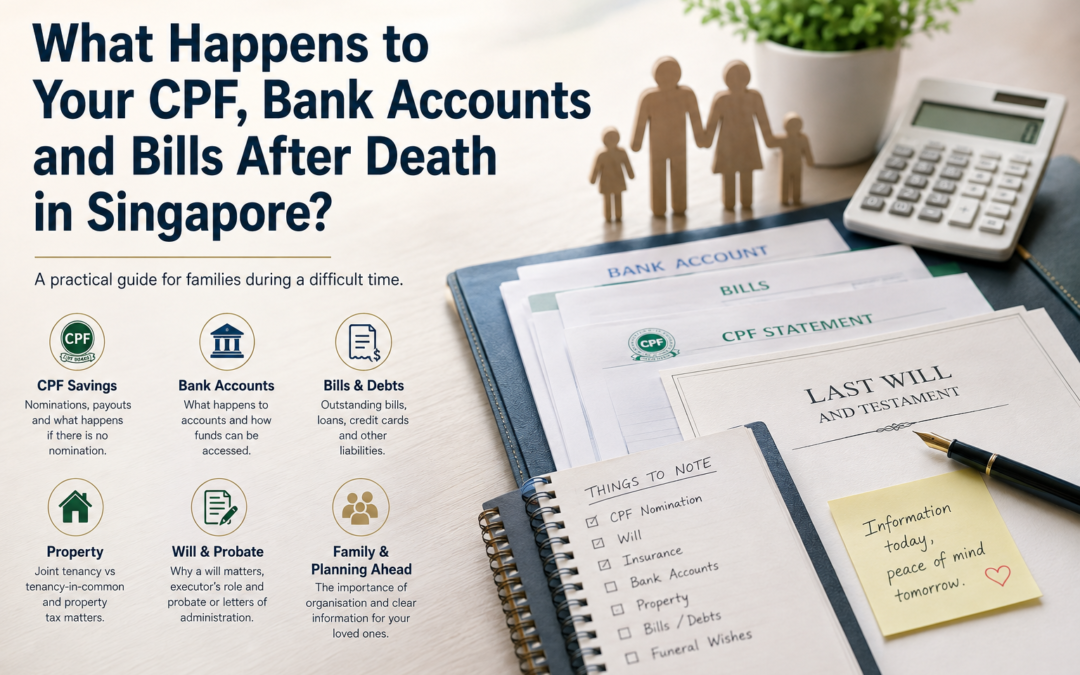
What Happens to Your CPF, Bank Accounts and Bills After Death in Singapore?
What Happens to Your CPF, Bank Accounts and Bills After Death in Singapore?
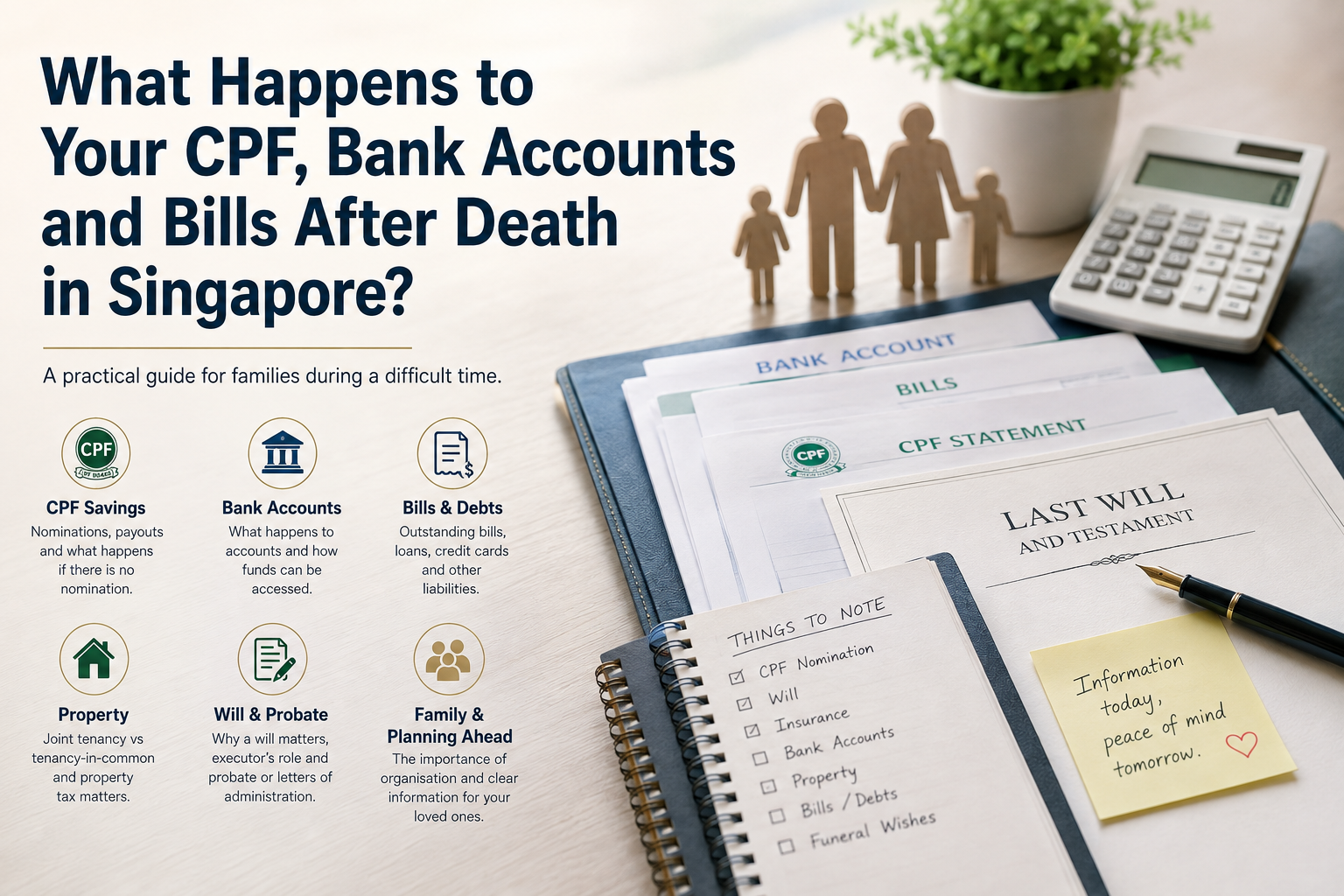
When someone passes away in Singapore, the funeral is often only the beginning of what the family needs to handle.
After the immediate arrangements are made, many practical questions start to surface:
What happens to the deceased person’s CPF savings?
Can the family withdraw money from their bank account?
What happens to credit cards, loans, utilities and outstanding bills?
Does a will cover everything?
These matters can become especially difficult when family members do not know what arrangements the deceased made beforehand.
This guide explains some of the key financial and administrative matters families should understand after a death in Singapore.
Important: This article provides general information only. Estate administration depends on individual circumstances, including whether there is a valid will, CPF nomination, jointly owned property or accounts, debts and other assets.
What Happens to CPF Savings After Death?
CPF savings are handled differently from many other assets.
One important point to understand is:
Your CPF savings are not distributed through your will.
According to the CPF Board, CPF savings covered by the CPF nomination scheme do not form part of your estate and cannot be distributed through your will.
Instead, what happens depends largely on whether you have made a valid CPF nomination.
What Happens If You Have Made a CPF Nomination?
A CPF nomination allows you to decide who should receive your CPF savings and the proportion each nominee should receive.
Upon your passing, CPF savings covered by your nomination will generally be distributed to your nominated beneficiaries according to your instructions.
CPF savings covered can include money remaining in your:
- Ordinary Account
- Special Account
- MediSave Account
- Retirement Account
Other CPF-related amounts may also be covered depending on the circumstances.
CPF savings are generally paid to nominees in cash, rather than transferred into their CPF accounts.
For deaths registered in Singapore, CPF Board is generally notified through the relevant government agencies and will contact the nominees.
What Happens If There Is No CPF Nomination?
A common misconception is that CPF savings will go to the Government if someone passes away without making a nomination.
That is not the case.
If there is no valid CPF nomination, the deceased’s CPF savings are generally transferred to the Public Trustee’s Office for distribution to the legally entitled beneficiaries according to the applicable inheritance laws.
CPF Board states that this process may take up to six months because the beneficiaries need to be identified and verified.
An administrative fee is also deducted from the CPF savings.
This is one reason making a CPF nomination can be useful.
Instead of leaving the distribution to the applicable intestacy rules, a nomination allows you to specify who should receive your CPF savings and in what proportion.
Does a Will Cover Your CPF Savings?
Generally, no.
This is one of the most important distinctions for Singapore families to understand.
You could have prepared a detailed will stating how you want your assets distributed, but your will does not determine how CPF savings covered by the CPF nomination scheme are distributed.
Think of them as two separate pieces of planning:
Your will deals with assets that form part of your estate.
Your CPF nomination determines how the CPF savings covered by the nomination are distributed.
Having a will therefore does not necessarily mean that your CPF arrangements are complete.
When Should You Review Your CPF Nomination?
Making a nomination once and forgetting about it for the next 30 years may not be ideal.
Life circumstances change.
Marriage, divorce, children and changes in family relationships may affect whom you want to receive your CPF savings.
There is one particularly important rule to know:
Marriage generally revokes an existing CPF nomination.
However, divorce does not automatically revoke a CPF nomination.
It is therefore worth reviewing your nomination after significant life events.
What Happens to a Property Bought Using CPF?
Property is treated differently from the CPF savings remaining in your CPF accounts.
Using CPF savings to purchase a property does not mean that the property will be distributed according to your CPF nomination.
What happens to the deceased person’s interest in the property depends partly on how the property is legally owned.
Joint Tenancy
If the property is owned under a joint tenancy, the deceased owner’s interest generally passes to the surviving joint owner or owners.
Tenancy-in-Common
If the property is held as tenants-in-common, the deceased person’s share generally forms part of their estate.
Property ownership can involve significant legal and financial considerations, so families handling an actual estate should seek appropriate professional advice where necessary.
What Happens to Bank Accounts After Death?
Bank accounts are another area where families should be careful.
If a bank account is held solely in the deceased person’s name, the money will generally need to be dealt with as part of the estate.
The bank may require documents establishing who has the legal authority to administer the deceased person’s estate before releasing the funds.
The exact procedure can depend on matters such as:
- whether there is a valid will
- whether there is an executor
- whether probate or letters of administration are required
- whether the account is solely or jointly held
- the amount held with the bank
- the bank’s own estate-administration procedures
Can Family Members Just Withdraw the Money?
Family members should not assume that having access to the deceased person’s ATM card, PIN or online banking credentials gives them the legal authority to withdraw or transfer money after the person’s death.
The appropriate estate-administration process should be followed.
This is also why it can be helpful for families to know which financial institutions a person uses, without needing access to their passwords.
What Happens to Joint Bank Accounts?
Joint accounts can be more complicated because the outcome can depend on the account arrangement, the bank’s terms and the circumstances.
Families should therefore contact the relevant bank after a joint account holder passes away rather than assuming that every joint account will be treated in exactly the same way.
The bank can advise what documents are required and how the account will be handled.
What Happens If There Is a Will?
A will allows a person to state how assets forming part of their estate should be distributed after death.
The will may also appoint an executor to administer the estate.
Depending on the circumstances, the executor may need to obtain a Grant of Probate before dealing with certain assets.
The executor’s responsibilities can include identifying estate assets and liabilities, settling debts and expenses, handling tax matters and eventually distributing the remaining assets to beneficiaries according to the will.
However, having a will does not mean that every asset is necessarily controlled by it.
CPF nominations, certain jointly owned assets and other nominated arrangements may operate separately.
What Happens If There Is No Will?
When someone passes away without leaving a valid will, this is commonly known as dying intestate.
Instead of an executor named by the deceased, an eligible person may need to apply for authority to administer the estate.
The estate will then be distributed according to the applicable intestacy laws rather than according to wishes that were never formally documented in a valid will.
This can become particularly important where there are multiple beneficiaries, property, businesses or complicated family circumstances.
Do Your Children Inherit Your Debts?
This is another common worry.
The simple answer is:
Your children do not automatically inherit your debts simply because they are your children.
Outstanding liabilities generally need to be identified and dealt with as part of administering the deceased person’s affairs and estate.
For example, IRAS states that outstanding tax liabilities of a deceased person are recovered from the deceased’s estate and are not passed on to surviving family members.
However, there can be different considerations for jointly held debts, secured loans, guarantees and other contractual arrangements.
Where substantial debts are involved, the executor or administrator may wish to obtain professional advice before distributing estate assets.
What Happens to Credit Card Bills?
A credit card balance does not simply disappear because the cardholder has passed away.
The family or estate representative should notify the card issuer.
The outstanding balance may need to be dealt with as a liability of the deceased’s estate.
Families should also check for recurring payments charged to the deceased’s credit cards, such as:
- mobile phone plans
- streaming services
- memberships
- insurance premiums
- online subscriptions
- software subscriptions
- other recurring services
This is one of those small administrative areas that can easily be forgotten during the first few weeks.
What Happens to Utility and Phone Bills?
Services do not necessarily know immediately that an account holder has passed away.
The family may therefore need to review ongoing accounts such as:
electricity
water
gas
mobile phone
internet
insurance
subscriptions
town council or property-related payments
Some services may need to be terminated.
Others may need to be transferred to another family member.
And some should remain active temporarily, particularly if family members are still living in the property.
Avoid cancelling everything immediately without first checking what the household still needs.
What Happens to Income Tax?
A person’s tax obligations do not necessarily end immediately upon death.
Income earned up to the date of death can still be subject to income tax.
The legal personal representative handling the deceased’s affairs may need to deal with IRAS regarding outstanding tax matters.
According to IRAS, outstanding tax liabilities are recovered from the deceased’s estate and are not passed on to surviving family members.
These liabilities should generally be dealt with before the remaining estate is distributed to beneficiaries.
Is There Inheritance Tax in Singapore?
Singapore no longer imposes estate duty for deaths occurring on or after 15 February 2008.
However, that does not mean every tax-related matter disappears after death.
There may still be outstanding:
- income tax
- property tax
- taxes relating to income generated by the estate
The estate representative should therefore make sure the deceased’s tax matters are properly addressed.
What Happens to Property Tax?
Property tax continues to require attention after a property owner passes away.
IRAS provides procedures for the legal personal representative of a deceased owner to handle property-tax matters.
There is also a concession relating to owner-occupier tax rates.
Under current IRAS guidance, owner-occupier tax rates may continue for up to two years from the owner’s passing or until the property is transferred, whichever is earlier, subject to the applicable conditions.
Families should therefore avoid leaving property ownership and estate-administration matters unresolved indefinitely.
What About CPF Investments?
There is another distinction that can easily be missed.
Investments purchased under the CPF Investment Scheme (CPFIS) are not handled in the same way as CPF savings covered by a CPF nomination.
CPF Board states that CPFIS investments and cash balances in the investment account generally form part of the deceased person’s estate.
The executor or administrator can approach the relevant investment provider or agent bank regarding these assets.
In other words:
CPF account savings and CPF investments are not necessarily treated the same way after death.
Do You Need to Settle Everything Immediately?
No.
When someone has just passed away, the family does not need to solve every financial and administrative matter on the first day.
The immediate priority is usually dealing with the necessary documentation and funeral arrangements.
Once those matters are under control, the person handling the deceased’s affairs can begin identifying:
- CPF matters
- bank accounts
- insurance policies
- investments
- property
- loans
- credit cards
- taxes
- utilities
- subscriptions
- other assets and liabilities
Keeping a record of these matters during your lifetime can make things considerably easier for the people handling them later.
The Problem Is Often Not Money. It Is Not Knowing.
Imagine this situation.
A parent passes away.
The children are already trying to arrange the funeral.
Then someone asks:
“Did Mum make a CPF nomination?”
Nobody knows.
“Is there a will?”
Nobody knows.
“Which bank accounts did she have?”
Nobody knows.
“Did she have insurance?”
Maybe.
“Where are the documents?”
Nobody knows.
And then:
“What kind of funeral did she actually want?”
Again, nobody is certain.
This is where advance planning becomes much bigger than choosing a funeral package.
It is about leaving clarity.
What Should You Prepare While You Are Still Well?
You do not necessarily need an enormous folder containing every detail of your life.
A simple record can already help your family understand where to begin.
Consider recording information such as:
- whether you have made a CPF nomination
- whether you have a will and where the original is kept
- your banks and financial institutions
- insurance policies
- investments
- properties
- significant loans or liabilities
- important recurring payments
- contact details for relevant professionals
- funeral preferences
- religious or cultural wishes
- preferred arrangements for your ashes
For security reasons, you do not need to leave banking passwords or PINs lying around.
The objective is to help the appropriate person identify what exists and where the relevant documents can be found.
Funeral Planning Is Only One Part of Preparing Your Family
People sometimes avoid advance funeral planning because they think:
“Why talk about these things when I’m still healthy?”
But planning ahead is not predicting when something will happen.
It is deciding what you want while you are still able to explain it yourself.
That could mean:
making a CPF nomination
preparing a will
organising important documents
reviewing insurance
telling your family where important information is kept
and
discussing your funeral and memorial preferences
None of these decisions removes the emotional difficulty of losing someone.
But they can reduce the number of decisions the family has to make during an already difficult period.
Don’t Leave Your Family With a Puzzle
You may know exactly what you own.
You know which bank you use.
You know where your insurance came from.
You know whether you want sea burial, a government columbarium or a private memorial arrangement.
But if nobody else knows, all of that information effectively becomes a puzzle after you are gone.
A little organisation today can make a significant difference later.
And when it comes to funeral and memorial arrangements, discussing your wishes early means your family does not have to guess what you would have wanted.
Planning Ahead With PlanFuneralSG
If you would like to understand funeral pre-planning, columbarium or memorial options available through Nirvana Memorial Garden, you can speak with:
Yvonne 敏如
Authorised Sales Agent of Nirvana Memorial Garden
Website: PlanFuneralSG.com
Planning ahead does not mean that you need to make an immediate purchase.
It can simply begin with understanding the available options, discussing them with your family and deciding what is appropriate for your circumstances.
Frequently Asked Questions
Does my will determine who receives my CPF savings?
Generally, no. CPF savings covered by the CPF nomination scheme do not form part of your estate and cannot be distributed through your will. A valid CPF nomination determines how those CPF savings are distributed.
What happens to my CPF if I don’t make a nomination?
Your CPF savings will generally be transferred to the Public Trustee’s Office for distribution to the legally entitled beneficiaries according to the applicable inheritance laws. Administrative fees may apply.
Does the Government keep my CPF if I don’t nominate anyone?
No. Not making a CPF nomination does not mean your CPF savings simply become Government money. They are generally transferred to the Public Trustee’s Office for distribution to the legally entitled beneficiaries.
Does marriage affect my CPF nomination?
Yes. CPF Board states that marriage revokes an existing CPF nomination. It is therefore important to review your nomination after marriage.
Does divorce automatically cancel my CPF nomination?
No. CPF Board states that divorce does not automatically revoke a CPF nomination. You should review and update your nomination if your wishes have changed.
Can my family withdraw money from my bank account after I die?
Family members should not assume they are authorised to use the deceased person’s ATM card, PIN or online banking credentials. The bank should be notified and the appropriate estate-administration process followed.
Do children inherit their parents’ debts in Singapore?
Children do not automatically become personally responsible for a parent’s debts simply because they are beneficiaries or family members. Liabilities generally need to be dealt with as part of the deceased’s estate. Different considerations may apply to joint debts, guarantees and other contractual obligations.
Is there inheritance tax in Singapore?
Singapore estate duty was removed for deaths occurring on or after 15 February 2008. Other tax matters, including outstanding income or property tax, may still need to be settled.
Should I organise these matters even if I am still young?
Planning is not limited to older adults. Anyone with CPF savings, insurance, property, dependants, bank accounts or other assets can benefit from keeping important information organised and making appropriate nominations and estate arrangements.
Official References
For the published article, I recommend linking primarily to government sources:
CPF Board: Making a CPF Nomination
CPF Board: What Happens to CPF Savings After Death
IRAS: When a Family Member Has Passed Away
Disclaimer
This article is intended for general educational purposes only and does not constitute legal, tax, financial or estate-planning advice. Estate administration varies according to individual circumstances, asset ownership, nominations, wills, debts and other arrangements. Government rules and procedures may also change. Readers should verify current requirements with the relevant government agencies, financial institutions or qualified professionals before taking action.
Information reviewed: August 2026.