
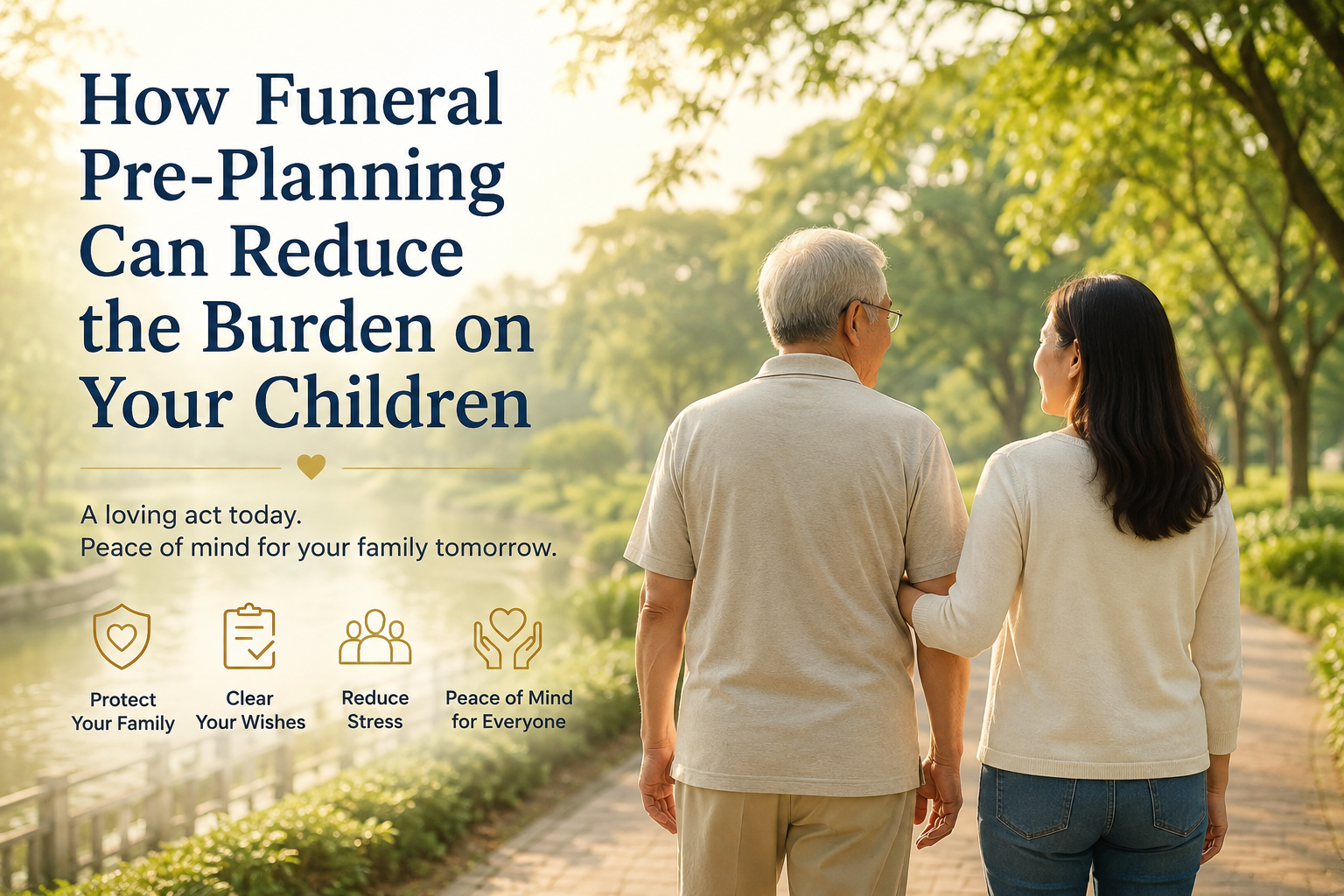
If your children had to make your funeral arrangements tomorrow, would they know what you wanted?
Most parents spend much of their lives thinking about their children.
We plan for their education, help them through difficult moments, worry about their future, and try to make life a little easier for them whenever we can.
But there is one form of planning that many families rarely talk about:
What happens when we are no longer around?
If your children suddenly had to arrange your funeral, would they know what you wanted?
Would they know whether you preferred a Buddhist, Taoist, Christian, secular or other type of funeral? Would they know your wishes for cremation or burial? Would they know what kind of memorial arrangement you preferred, or how much should reasonably be spent?
These can be difficult questions to answer while a family is grieving.
Funeral pre-planning is therefore not simply about preparing for the end of life. For some parents, it is a way of leaving their children with clarity instead of uncertainty.
Why Funeral Decisions Can Be Difficult for Children
When someone passes away, their family may need to make many decisions within a relatively short period.
At the same time, they are dealing with grief, informing relatives and friends, handling administrative matters and supporting one another.
Questions may quickly arise:
- What kind of funeral would Mum or Dad have wanted?
- Which religious or cultural traditions should we follow?
- How many days should the wake be?
- Should there be cremation or burial?
- What funeral services do we actually need?
- What budget would be appropriate?
- Where should the ashes be placed after cremation?
- Did Mum or Dad ever express a preference for a columbarium?
- Who should we contact to make the arrangements?
When wishes have never been discussed, children may have to make these decisions on their parents’ behalf.
Even with the best intentions, siblings can sometimes have different opinions about what their parents would have wanted.
Planning ahead can remove some of this uncertainty.
What Is Funeral Pre-Planning?
Funeral pre-planning simply means considering and recording some of your funeral and memorial preferences before they are urgently needed.
It can be as simple or as detailed as you want.
For example, you might think about:
Funeral preferences
Consider the type of funeral you would prefer and any religious or cultural traditions that are important to you.
Cremation or burial
You can let your family know your preference rather than leaving them to make the decision later.
Wake arrangements
You may have preferences regarding the location, duration or type of wake.
Memorial arrangements
If you prefer cremation, you may also want to consider what should happen to your ashes and whether a columbarium or another memorial option would be suitable.
Financial preparation
Understanding likely funeral and memorial expenses can help you decide how you would like these costs to be managed.
Important contacts
You can record who your family should contact when the time comes, including relatives, religious representatives or funeral planning professionals.
Pre-planning does not necessarily mean that you have to purchase a funeral package immediately.
Sometimes, the first and most valuable step is simply understanding the available options and having a conversation with your family.
6 Ways Funeral Pre-Planning Can Make Things Easier for Your Children

1. Your Children Don’t Have to Guess What You Wanted
One of the biggest benefits of planning ahead is clarity.
Without instructions, your children may find themselves asking:
“What would Mum have wanted us to do?”
When your wishes have already been discussed or documented, they have something to guide their decisions.
That can be reassuring during an emotionally difficult period.
2. It Can Reduce the Number of Decisions They Need to Make
Funeral arrangements involve many choices.
Some are significant, while others may seem surprisingly small until someone has to make them.
By deciding some things in advance, you can reduce the number of questions your children need to answer at once.
Instead of starting from zero, they can follow the preferences you have already communicated.
3. It Can Reduce Disagreements Between Family Members
Different children may remember different conversations with their parents.
One sibling might believe Dad wanted a simple funeral.
Another might remember him talking about a particular religious ceremony.
Neither person is necessarily wrong.
But when wishes are unclear, disagreements can arise at precisely the time when the family most needs to support one another.
Having your preferences documented can provide a common reference point.
4. It Gives Your Family Greater Financial Clarity
Funeral arrangements involve costs, and families may not know what their parents expected them to spend.
Should the funeral be simple?
Were certain arrangements particularly important?
Was money already set aside?
Was a funeral or memorial plan purchased previously?
Having these conversations in advance can help prevent children from feeling that they need to choose the most expensive option simply because they are afraid of “not doing enough”.
A meaningful farewell does not have to be measured by how much a family spends.
5. It Gives Your Children More Space to Grieve
When someone passes away, practical responsibilities begin very quickly.
Documents have to be obtained. Funeral arrangements have to be made. Relatives need to be informed. Ceremonies need to be coordinated.
Some of these responsibilities cannot be avoided.
But decisions that have already been made don’t need to be made again.
Pre-planning can therefore give your family a little more space to focus on what matters most:
remembering you and supporting one another.
6. Your Children Can Feel Confident They Are Honouring Your Wishes
After a funeral, family members sometimes wonder:
“Did we do what Mum would have wanted?”
Clear instructions can provide reassurance.
Rather than making assumptions, your children can know that the arrangements reflect choices you considered yourself.
For many parents, that peace of mind is one of the most meaningful reasons to plan ahead.
What Funeral Wishes Should You Discuss With Your Family?
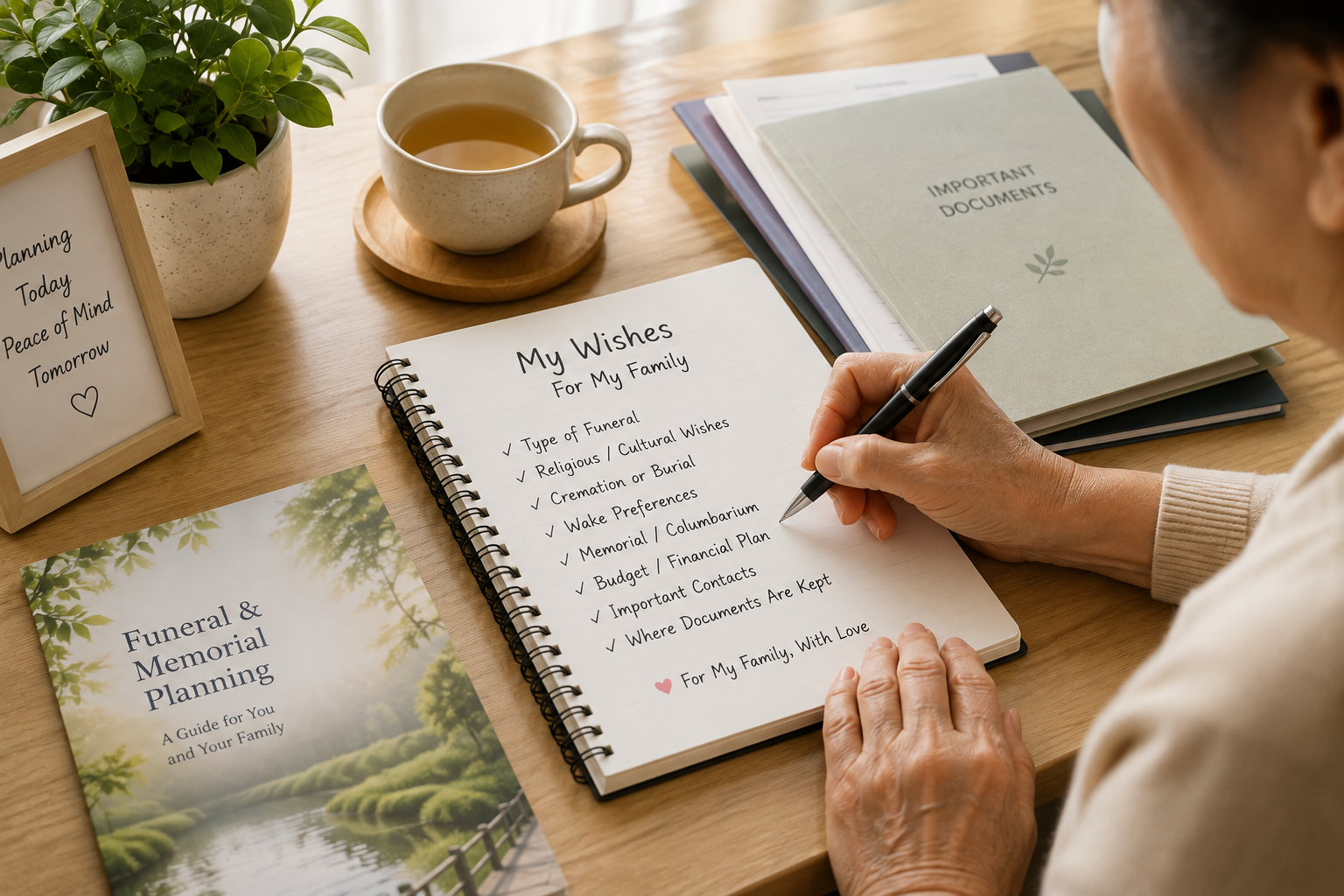
You don’t need to plan every detail.
A simple conversation can already make a meaningful difference.
You may want your family to know about:
Funeral arrangements
- Preferred type of funeral
- Religious or cultural traditions
- Preferred wake arrangements
- Approximate number of wake days
- Any ceremonies or customs important to you
Final arrangements
- Cremation or burial preference
- Preference for handling or placement of ashes
- Columbarium or memorial preferences
Financial matters
- Whether money has been set aside
- Existing funeral or memorial plans
- Insurance policies that may be relevant
- Where important documents are stored
People to contact
- Close relatives
- Religious representatives
- Funeral planner or funeral director
- Other important people who should be informed
You don’t necessarily need a complicated document.
The important thing is that your family knows your wishes exist and knows where to find them.
Should You Talk to Your Children About Your Funeral Wishes?
For many Singapore families, conversations about death can feel uncomfortable.
Some parents worry that discussing funeral arrangements will upset their children.
Children may respond with:
“Why are you talking about this? You’re perfectly healthy.”
But planning ahead doesn’t have to be a gloomy conversation.
Families already make plans for many future possibilities through wills, insurance, CPF nominations and estate planning.
Funeral wishes can simply be another part of making sure important matters are organised.
You could begin with something as simple as:
“There’s nothing wrong. I just want you to know what I would prefer one day, so you won’t have to guess.”
Sometimes that one conversation is enough to open the door.
What If You Haven’t Decided Everything Yet?
That’s completely fine.
Funeral pre-planning does not need to happen in one sitting.
You can begin by asking yourself a few basic questions:
What matters most to me?
Are there religious or cultural traditions I want my family to follow?
Would I prefer cremation or burial?
If cremated, what would I like my family to do with my ashes?
Would I prefer a simple arrangement or something more elaborate?
Is there anything I definitely do not want?
From there, you can learn about the options available in Singapore before making further decisions.
Funeral Pre-Planning Options in Singapore
There are different aspects of funeral pre-planning to consider.
Some families focus first on funeral services.
Others may also want to understand longer-term memorial arrangements, including columbarium niches and other options for the placement of ashes.
Private memorial providers such as Nirvana Memorial Gardens Singapore offer funeral and memorial planning options that families can explore in advance.
However, there is no need to rush into a decision.
Before choosing any funeral or memorial arrangement, understand what is included, the associated costs, your family’s religious or cultural requirements, and whether the arrangement suits your long-term preferences.
Comparing your options before making a commitment is part of responsible pre-planning.
Planning Ahead Is Ultimately About Your Family
Thinking about our own funeral can feel uncomfortable.
But there is another way to look at it.
We spend much of our lives making things easier for the people we love.
We prepare financially. We organise important documents. We make plans for our children and grandchildren.
Funeral pre-planning can simply be another part of that responsibility.
You cannot remove the sadness your family may feel one day.
But you can remove some of the uncertainty.
You can give them instructions instead of questions.
You can give them preparation instead of rushed decisions.
And perhaps most importantly, you can give them the reassurance that they are carrying out your wishes.
Sometimes, planning for ourselves is also an act of care for the people we leave behind.
Need Help Understanding Funeral Pre-Planning Options?
If you’re considering funeral or memorial pre-planning in Singapore, you don’t have to make every decision immediately.
Start by understanding your options.
Yvonne (敏如) is an authorised sales agent of Nirvana Memorial Gardens Singapore and can guide families through available funeral pre-planning and memorial options, including helping you understand what may be suitable for your family’s preferences and needs.
There is no need to make a decision before you understand the arrangements clearly.
Mobile: 9222 3271
Website: PlanFuneralSG.com
Email: admin@planfuneralsg.com
Frequently Asked Questions
Is funeral pre-planning necessary in Singapore?
It is not something every family chooses to do, but planning ahead can help your family understand your preferences and reduce the number of decisions they may need to make after your passing.
At what age should I start planning my funeral?
There is no single correct age. Funeral pre-planning can be viewed as part of broader life and estate planning rather than something that only needs to happen at an advanced age.
Do I have to purchase a funeral package to pre-plan?
No. Pre-planning can begin simply by learning about your options, discussing your wishes with your family and documenting important preferences. Purchasing a plan is a separate decision.
Should I tell my children about my funeral wishes?
If you are comfortable doing so, discussing your wishes can help prevent uncertainty later. At minimum, someone you trust should know where your important documents and instructions are kept.
Can my funeral wishes change?
Yes. Personal preferences and family circumstances can change over time. It is sensible to revisit your plans periodically and update your family if your wishes change.
What should I prepare for my family?
Consider documenting your funeral preferences, religious or cultural wishes, cremation or burial preference, memorial preferences, relevant plans or policies, important contacts and the location of essential documents.